Showing posts with label chronic kidney disease. Show all posts

Aristolochic Acid Nephropathy

Aristolochic acids (AA) are found in products derived from the aristolochia genus of plants which are used extensively in herbal medicines, particularly in Asia. Nephrotoxicity resulting from AA exposure was originally described in a case series of women taking diet supplements in Belgium but has subsequently been identified in the US, Europe and Asia. Consumption of products containing AA remains endemic in some areas with an estimated exposure in up to 40% of the Taiwanese population. The disease known as Balkan endemic nephropathy – described the population living around tributaries of the Danube river- is now thought to result from contamination of wheat flour with seeds of plants containing AA.
Patients with AA nephropathy typically present with renal insufficiency and anemia. Urinalysis reveals a few red cells and mild proteinuria. The rate of decline of renal function varies but may depend on the cumulative dose of AA. Renal histology is characterized by extensive interstitial fibrosis with tubular atrophy and low numbers of inflammatory cells. There is a very high incidence of urothelial atypia and carcinoma. Exposure to AA can be confirmed by the presence of AA-DNA in biopsy tissue. 
Therapy consists of routine management of CKD alongside regular screening for urothelial malignancy. A trial of steroids can be considered in selected patients. The risk of urothelial malignancy is so high that some consider patients for bilateral nephrouretecomy once RRT as been established.
Despite being banned in many countries, products containing AA remain available. The true incidence of CKD and urothelial malignancy resulting from AA exposure remains unknown. It is possible that a lack of awareness means that a significant proportion of AA resulted morbidity remains undiagnosed.  For a comprehensive review of the subject see here.
Image from Wikipedia.
Posted by Jonathan Dick

Statins and Chronic Kidney Disease

There is an excellent review of the use of statins is CKD in KI from last month. The authors point out that the association between LDL cholesterol and CVD is not as strong in patients with CKD, particularly in stages IV and V. In fact, the clearer association between hypertriglyceridemia, low HDL and CVD in patients with advanced CKD suggests that statins may not be the best treatment in this setting. The results of clinical trials are conflicting. However, the authors of the current study came up with some suggested guidelines for the management of hyperlipidemia in CKD reproduced below:

1. LDL cholesterol-lowering strategies include either statins or ezetemibe, or both, and target the reduction of LDL to <70 mg/dl as recommended for patients with CVD or an equivalent disorder in the general population
2. Start LDL cholesterol-lowering treatment in stages 1-4 CKD patients with preexisting CV events or those with multiple risk factors and at high risk for coronary heart disease and LDL cholesterol > 70 mg/dl
3. Continue LDL cholesterol-lowering strategies in patients developing CKD stage 1 or more or those starting dialysis who were previously on such treatment
4. Do not use LDL cholesterol-lowering strategies in CKD patients with inflammation/malnutrition, nor start such treatment in dialysis patients who are treatment-naive until additional literature data in favor of a different therapeutic approach become available

What do you think? Do these recommendations make sense?

Thromboembolic Prophylaxis in Patients with AFib and CKD: Caught between the Devil and the Deep Blue Sea


I often get curb-sided by cardiologists and internists for my opinion on using warfarin or other anticoagulants for thromboembolic risk prophylaxis in CKD +/- Afib patients. A similar conundrum of using anticoagulation for stroke prophylaxis in dialysis patients was discussed about three years ago on this blog by Conall. Like many other issues in patients with CKD, things are not always black-and-white, and a lot could depend on patient and physician preference.  This often makes the “right answer” a confusing exercise, since CKD patients are also at a higher bleeding risk. Most randomized trials addressing this issue have excluded patients with a GFR below 30. Furthermore, newer direct thrombininhibitors (dabigatran), or Factor Xa inhibitors(apixaban, rivaroxaban) are available, which might be better than warfarin, at least in the early-CKD patient (although the lack of a reversing antidote is a potential pitfall). Finally, warfarin has a well-established link with vascular calcification (a mortality risk) in dialysis patients. As nephrologists, it is imperative that we are knowledgeable about the best-available data that can help us make an evidence-based recommendation, and so I put together a concise decision-table with links to primary literature sources.
In addition to the “traditional” risk factors for stroke in patients with AFib (as exemplified by the acronym CHADS), it is known that CKD itself is an independent risk factor for stroke. Thus CKD patients, both with, and without AFib, are at an increased risk of stroke. This has been demonstrated in CKD as well as dialysis patients, and the risk worsens with decline in GFR. 
Thus, with the above background in mind, the two main variables that determine what, if any, anticoagulation is to be used in this setting, are (1) the stage of CKD, and (2) the CHADS2 score:


CHADS2 Score

CKD STAGE


Stage 3, eGFR 30-59
    

Stage 4, eGFR 15-29

Stage 5, eGFR less than 15, or dialysis


0


>1

AC (Direct thrombin inhibitors (dabigatran), and Factor Xa inhibitors (rivaroxaban, apixaban) potentially superior to warfarin


AC (warfarin preferred since no data on direct thrombin or factor Xa inhibitors)

AC (warfarin preferred since no data on direct thrombin or factor Xa inhibitors)
 

ASA = Aspirin
AC = Anticoagulation
?? = Expert opinion only, no strong evidence available - weight risks vs. benefits
Remember that no antithrombotic therapy is warranted if bleeding is a concern

Posted by Veeraish Chuahan

(Apologies for any formatting issues)

Diabetes and CKD - Pitfalls: Estimating GFR

The routine use of estimating equations for GFR has revolutionized the way that we view renal disease over the last 15 years and although some argue that this has lead to overdiagnosis of CKD, I believe that this has been an extremely positive development both in clinical and research terms. One criticism of the MDRD equation in particular was that it did not perform well in patients with near normal GFR and the CKD-Epi equation was introduced, at least in part, because of this limitation. However, there remain concerns that in patients with diabetes, particularly in those with hyperfiltration, this formula still does not perform sufficiently well.

To answer this question researchers in Italy took patients from two clinical trials who had serial measured GFR for up to 8 years and compared the results with simultaneous estimates of GFR using the 14 different equations. Of the 600 patients included, 15% were hyperfiltering and 13% had a reduced GFR. Overall, all but one of the equations underestimated GFR in the group as a whole. The single equation that overestimated GFR (Ibrahim) tended to overestimate at all levels. The range of differences between the mGFR and eGFR was -40 to +20 ml/min/1.73m2 and the mean percent error (MPE) ranged from -28.14 to 0.98%. Not unexpectedly, the majority of the error was related to underestimation of GFR in patients with hyperfilatration (MPE -12.8 to -36.7%). It is notable that the MPE was lowest in participants with hyperfiltration using the CKD-Epi equation. In this group, the mean mGFR was 132 ml/min/1.73m2 while the mean eGFR ranged from 83-114 ml/min/1.73m2.

The bias was far lower for the normofiltration and low GFR groups. Because the authors had longitudinal data also, they were able to look at the ability of the formulas to measure GFR decline over time. Given that all of the equations underestimated GFR at baseline, it is unsurprising that there was systematic underestimation of GFR decline over time, particularly in the patients with hyperfiltration. This was less marked in the patients with CKD at baseline. Five of the equations actually estimated that GFR was increasing in the patients despite a consistent decline in mGFR.


This is all not to say that these formulas are not useful. It is always important to recognize the limitations of your tools and one of the major issues here is that creatinine is used as the marker of kidney function with all of the limitations that this introduces. It should also be said that although the agreement with mGFR might not be great, we know from large EPI studies that an eGFR of less than 60 ml/min/1.73m2 is associated with poorer outcomes and this is true no matter what the cause of the disease. The take home from this is that it is not possible to accurately diagnose hyperfiltration in diabetic patients without over nephropathy using current creatinine-based estimating equations and that other signs should be taken into account when assessing these patients.

(Click on images to enlarge)

Does she drink tea?


I was quickly moving along through my busy university clinic, seeing another CKD patient when the nurse came to inform me that the patient’s hemoglobin was critically low at 5 g/dl, while the patient appeared to be just fine. I reviewed the rest of labs just to find out that the iron studies were even more impressive: iron saturation 3% and ferritin 2 ng/ml.
I inquired about the usual suspects - bleeding from various sources - but no luck there (the patient was post-menopausal and denied GI bleeding, later ruled out by EGD and colonoscopy)... Failing to identify a cause of her iron deficiency, I presented the case to my staff who, after reviewing the data, asked me an unusual question: does she drink tea? To my surprise, indeed, the patient admitted to drinking large quantities of black tea. Still puzzled about the link between the two, I jumped onto Google Scholar.
In the renal world, the only time when we talk about tea is when discussing hyponatremia in patients that are on a “tea and toast” diet. So what did I find out? An interesting South African study demonstrated that black tea inhibits non-heme iron absorption by forming iron tannate complexes. This was confirmed by a UK study which showed that black tea was the most potent out of all polyphenol-rich beverages (coffee, cocoa, etc.) in inhibiting absorption of non-heme iron.
Iron deficiency anemia is common in CKD patients, one of the latest mechanisms to be described involves the hepcidin-ferroportin axis (as recently reviewed in JASN). But today I discovered another one!

Posted by Tomoki Tsukahara

Bardoxolone - Part 3

Last year, we had a post about Bardoxolone for the treatment of diabetic nephropathy. After one year of treatment, eGFR increased significantly in patients treated with Bardoxolone relative to controls. At the time, significant concerns were raised about the fact that albuminuria also increased in patients receiving the drug and it was uncertain both what the mechanism of this was and whether there would be any deleterious consequences. 

This week, an article was published in JASN which goes some way towards explaining the reason for the proteinuria. Under normal circumstances, a significant quantity of albumin is filtered in the glomerulus. Almost all of this albumin is reabsorbed in the proximal tubule by the cubilin-megalin complex. Defects in cubilin and megalin have been associated with albuminuria in animals and humans. It turns out that Bardoxolone downregulates the expression of megalin in monkeys in the proximal tubule. Thus, the increase in albuminuria may be due to decreased effectiveness of the retrieval process. At one year, there were no significant differences in renal histology between the treated monkeys and controls. 

This is a fascinating finding. There has been a lot of work done in the last few years regarding the effect of albuminuria itself on renal fibrosis. Even in the absence of any vascular changes, overload albuminuria is associated with increased fibrosis in animal models. So, why is there no damage seen in these monkeys? One of the postulated mechanisms of albuminuria-induced fibrosis is that megalin itself acts as a transmembrane receptor and stimulates EGF production in the presence of excess tubular albumin. This ultimately leads to increased interstitial fibrosis. The loss of megalin in treated monkeys means that this pathway might be downregulated. It should be said that these were healthy monkeys and the effect in humans with more albuminuria at baseline could be different. That said, this study goes some way towards alleviating some of the concerns that were raised last year.

More Fruit Please

Current Opinions in nephrology and hypertension has an excellent review this month on the rationale for bicarbonate treatment to slow the progression of CKD. The original data animal data was derived from the 5/6 nephrectomy model where rats fed with an acid chow developed metabolic acidosis and had relatively rapid GFR decline that could be ameliorated by giving the rats sodium bicarbonate. Interestingly, switching them to a low-acid, soy-based diet had a similar effect suggesting that simply reducing net acid intake is just as effective. The same group developed a 2/3 nephrectomy model in rats where they did not develop acidosis but the decline in renal function could still be slowed by treatment with bicarbonate. Current guidelines in humans suggest that patients should be prescribed bicarbonate when the TCO2 is less than 22 but recent studies have suggested that even above this level, patients with a reduced GFR may have net acid retention in the kidney with a potential for consequent renal injury that could be prevented by alkali treatment. This, of course is balanced by the fact that we do not want to give large quantities of sodium to patients with CKD.

One suggestion is to look closer at the diet of patients with CKD. The biggest source of dietary acid is animal protein and reducing meat intake will reduce overall acid intake (in contrast, we all see elderly malnourished patients on dialysis with high pre-dialysis bicarbonate levels that is actually a negative prognostic sign). The DASH diet is high in fruits and vegetables and is already a first line treatment for hypertension. Because it has a high component of fruits and vegetables, it has a high alkali content and could substitute for exogenous bicarbonate treatment in some patients. The trade-off is that it is also high in potassium and this would need to be carefully monitored in patients with a low GFR. The take home for me is that this explains, at least in part, the deleterious effects of a diet high in animal protein in patients with CKD and that we can potentially treat acidosis in these patients without resorting to large quantities of oral sodium bicarbonate. See this previous post on the benefits of bicarbonate therapy in patients with mild CKD.

Under Pressure


As a medical student I was taught the CKD hypertension gospel straight from the good book of JNC VII: Thou shalt lower the blood pressure to less than 130/80! This was many years after David Bowe and Freddie Mercury but I got the song stuck in my head when I started thinking about the post so I had to put it up there.

I lived happily with this for many years until one day someone questioned me. Why should you lower the blood pressure to less than 130/80 in someone with chronic kidney disease? Well 'cause the JNC VII says so! Check it out...


Right there in red, blue and black. And supported by two references no less! One of them is the American Diabetic Association going on about diabetes (another story) but reference 21 is KDOQI on CKD... So the rabbit hole gets deeper.

Over at KDOQI we get the following...


They say "controlled trials in essential hypertension conclusively show a beneficial effect of lowering blood pressure to <140/90 mm Hg. Controlled trials in high-risk individuals with diabetes or heart failure suggest beneficial effects of reduction of blood pressure to even lower values. Based on these studies, and on observational studies, a number of guidelines for patients with either diabetes mellitus or congestive heart failure recommend a goal blood pressure of <130/80 mm Hg. There are few studies regarding blood pressure goals for CVD risk reduction in patients with CKD. Thus, the Work Group elected to extrapolate the recommendations for high-risk patients to patients with CKD."

Uhh so, we have no evidence so we took some evidence from other diseases and said do the same thing. It not quite that bad. There is some evidence for less than 130/80 but it has caveats.

The MDRD study randomized patients to aggressive vs standard blood pressure control with achieved average values of 126/77 and 133/80 respectively. At the end of the study there was no overall difference between the two groups in terms of kidney function but in post-hoc analysis the aggressive BP arm had statistically slower rates of renal function decline in patients with over 1g per day of proteinuria mainly driven by patients with over 3g of proteinuria per day. Unfortunately, the aggressive control group were more likely to have received ACE inhibitors than the standard control group so the post-hoc data is a bit muddled.

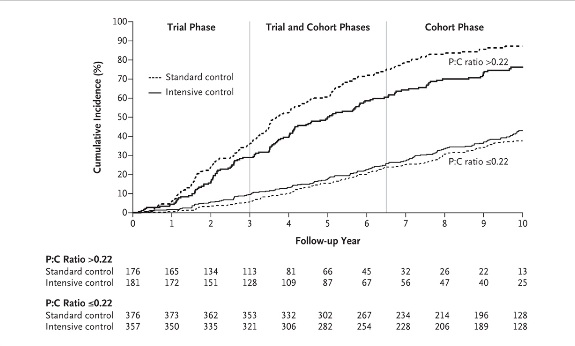
In the recently published long term followup of the AASK trial, African Americans with hypertensive kidney disease who were initially randomized to either intensive or standard BP control were subsequently followed in a cohort phase in which the BP target was the same in both groups. Followup extended out to 12 years from the initial randomization. The achieved BPs during the trial were 130/78 mm Hg vs 141/86 mm in the intensive and standard groups respectively. In the cohort phase BPs were much closer as expected (131/78 and 134/78 in the intensive and standard groups respectively).

The story is similar to MDRD, among all patients there was no difference in the primary composite outcome of ESRD, doubling of serum creatinine or death throughout the trial and cohort phase. However, in the subgroup with baseline proteinuria of greater than 220 mg per day a significant difference between BP target groups appeared favoring more intensive control.


So no clean randomized prospective data to support the JNC VII target of less than 130/80 in CKD patients. There is a hint from the above subgroup analyses that CKD patients with proteinuria might benefit from having blood pressures controlled to below 130/80. The proteinuria cutpoint at which this might occur is unclear.

It will be interesting to see how JNC VIII, expected sometime later this year, handles the above. Additional information will hopefully come from the randomized prospective SPRINT trial which is looking at systolic BP goals of 140 vs 120 in a large cohort with a reasonable proportion of CKD patients.

Lead Nephrotoxicity

I saw a patient in the clinic who was referred for evaluation by his PCP with CKD, a bland urine sediment and a history of hyperuricemia and gout. He had no history of diabetes or hypertension and had no obvious (to me) reason for his CKD at first glance. He was a non-smoker and had no family history of renal disease. He worked as a plumber and his examination was entirely normal.

My attending came in and asked him if he was still using as much lead these days as he had in the past – apparently he was down to 4 times monthly. He was using it to fix joints and was regularly exposed to lead vapor. Even at this, his exposure was significantly less than it had been when he was younger before work practices changed.

Lead toxicity is an under-recognized cause of chronic kidney disease. Commoner in the past when lead was ubiquitous and likely less important now as an environmental cause of renal disease, it should be suspected in people who still work with lead regularly (or had a significant past exposure). Plumbers, fishermen (who make their own weights) and hunters (who make their own shot) continue to be at risk.

The renal signs of lead toxicity depend on the duration and degree of exposure. Acute lead toxicity leads to proximal tubular inclusions and an acute fanconi syndrome. Chronic lead toxicity causes a chronic interstitial nephritis with a relatively bland urine sediment. Patients typically have gout and this condition has sometimes been confused with uric acid nephropathy. Even low levels of lead exposure appear to be associated with a decline in GFR. A study in 1992 in the NEJM found that a 10-fold increase in blood lead concentration was associated with a 10-13mls/min decline in GFR in a population of asymptomatic patients. There is a chicken and egg issue here however, as a lower GFR can lead to decreased lead excretion.

The diagnosis is made by first determining if the patient has been exposed to significant amounts of lead and then measuring lead levels in the blood. In patients with a historic exposure, this may not be reliable because of sequestration in the bone and x-ray fluorescence is more reliable.

The treatment involves removing the sources of exposure and, in patients with substantial lead toxicity, chelation therapy. This is not entirely without risk and has been associated with acute renal failure in children. Chelation in the presence of ongoing exposure will actually increase toxicity as it will lead to an overall increase in blood levels.

We are in the process of getting the XFR scan for this patient and it may be that he does not have lead toxicity after all; but it is definitely one to think about in the future.